
Understand what an offshore licence actually covers
 Available in US
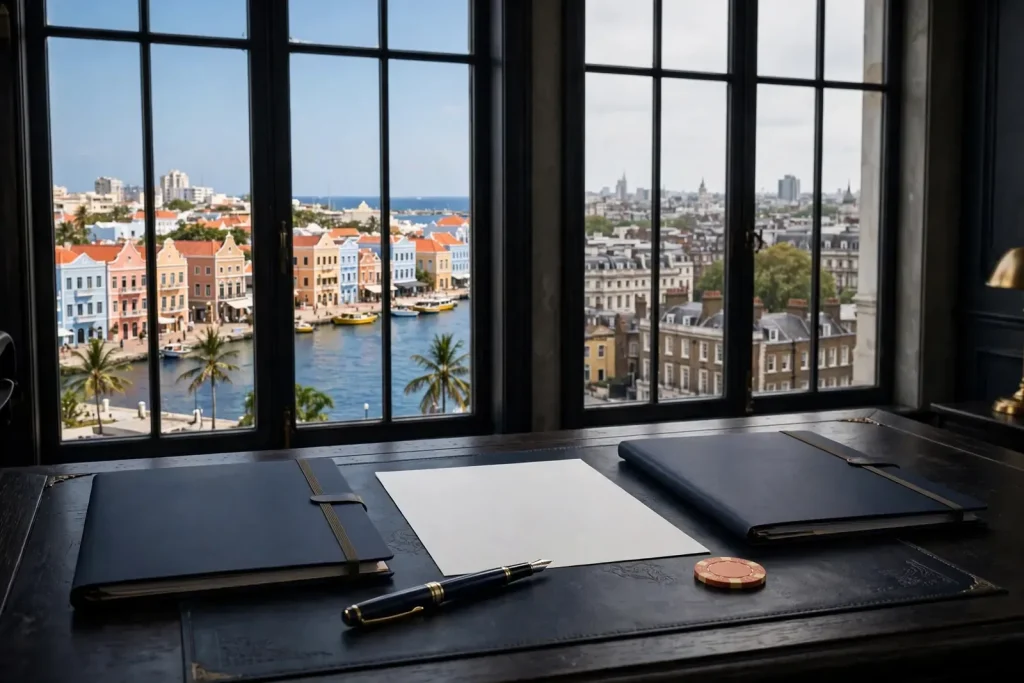
A Curaçao licence concerns an operator’s approval in that jurisdiction; serving customers in Great Britain is a separate licensing question.
What a Curaçao Casino Licence Does—and Doesn’t—Tell You
A Curaçao casino licence tells you that an operator claims regulatory approval in Curaçao. It does not, by itself, give that operator permission to offer gambling to customers in Great Britain. Those are separate questions: one concerns the operator’s licensing jurisdiction; the other concerns the rules for supplying gambling services to the British market.
That distinction matters when you see a site described as a Curaçao casino or a Curaçao-licensed casino available to UK players. The wording can make the licence sound like a general passport for serving customers internationally. It isn’t. A licence from outside the UK does not replace the authorisation required under British law.
The rule for Great Britain is straightforward: an operator serving customers there must hold a licence from the UK Gambling Commission, wherever the company is based. A business does not avoid that requirement by running its website from abroad or holding a licence issued by another jurisdiction. Its location and the market it serves are different parts of the picture.
If you’re considering a casino associated with a Curaçao licence, check its licensing status and whether it is authorised to serve customers in the UK. The listed payout times offer one practical detail to consider.
-
WinBeast
- Payout speed
- 1-3 business days
You can use the stated payout speed as a reference: 1–3 business days.
-
Chanze
- Payout speed
- 1-3 business days
You can use the stated payout speed as a reference: 1–3 business days.
-
Zombillion
- Payout speed
- 1-3 business days
You can use the stated payout speed as a reference: 1–3 business days.
-
EvoSpin
- Payout speed
- 1-3 business days
You can use the stated payout speed as a reference: 1–3 business days.
-
Dieselwin
- Payout speed
- 1-3 business days
You can use the stated payout speed as a reference: 1–3 business days.
-
SlotoSport
- Payout speed
- 1-3 business days
You can use the stated payout speed as a reference: 1–3 business days.
-
NightWin
- Payout speed
- 1-3 business days
You can use the stated payout speed as a reference: 1–3 business days.
-
SpinFormula
- Payout speed
- 1-3 business days
You can use the stated payout speed as a reference: 1–3 business days.
-
Revery Play
- Payout speed
- 1-3 business days
You can use the stated payout speed as a reference: 1–3 business days.
-
Britsino
- Payout speed
- 1-3 business days
You can use the stated payout speed as a reference: 1–3 business days.
So, if you are trying to understand what a Curaçao casino licence means for a UK reader in 2026, start with the boundary between the two systems. Curaçao licensing is not the same as UK Gambling Commission licensing. A site may make a claim about its overseas status, but that claim does not establish that it is authorised to serve Great Britain.
A non-UK-regulated casino is, in this context, an online gambling site operating without oversight from the UK Gambling Commission. That description is about its relationship with the British regulator, not a judgement about every detail of the operator or its games. The key point is that a foreign licence and UK authorisation are not interchangeable labels.
The Gambling Act 2005 is directed at operators supplying gambling services into the UK market, rather than at individual players. That helps explain why legal responsibility and licensing requirements should not be muddled together. The requirement on an operator to hold the relevant UK licence is not removed because a customer is in another legal position.
There is a further geographic detail worth keeping clear. The licensing requirement described here applies to operators serving customers in Great Britain. Great Britain means England, Scotland and Wales; it is not another name for the whole United Kingdom. The legal position should not be casually extended to Northern Ireland on the basis of the same rule.
In practical terms, a Curaçao licence may tell you something about where an operator says it is regulated. It does not tell you that the UK Gambling Commission has approved the site, nor does it satisfy the British licensing requirement for an operator serving Great Britain. Keep those statements separate. The distinction is simple, but easy to miss when a website presents an overseas licence as the main reassurance.

Curaçao, Anjouan and Other Offshore Licensing Jurisdictions
A casino’s licence points to a regulator and a legal framework; it is not a universal pass to operate wherever its website can be reached. Non-UK-regulated casinos may be licensed in places such as Curaçao, Malta, Gibraltar or Anjouan. Those names describe different jurisdictions, not interchangeable versions of one licence.
That distinction matters when you come across a Curaçao gaming licence claim. It tells you which jurisdiction the operator says oversees it; it does not, by itself, settle whether the casino is authorised to serve people in Britain. A Curaçao casino licence and permission to operate in the UK are separate questions. So if you’re wondering whether a Curaçao casino is legal in the UK, the jurisdiction named on its site is not the whole answer.
The same caution applies to ratings. A high score on a casino-rating page might reflect the reviewer’s view of the site, but it cannot turn one jurisdiction’s licence into another’s or establish permission to serve a particular market. I treat licensing and ratings as different kinds of information. One concerns the stated regulatory framework; the other is an assessment, and its usefulness depends on what it actually evaluates.
Curaçao is one of several jurisdictions associated with non-UK-regulated casinos. Malta and Gibraltar are other examples, and Anjouan is another. Naming them together does not mean their rules, safeguards or permissions match. Nor does a licence from any one of them automatically carry the authority of another. The label is specific to the jurisdiction that issued it.
Curaçao
An offshore jurisdiction associated with non-UK-regulated casinos.
Anjouan
Another offshore jurisdiction with its own specific rules and restrictions.
Malta
One of several jurisdictions where non-UK-regulated casinos may be licensed.
Gibraltar
An example of a licensing jurisdiction separate from the UKGC framework.
Anjouan is a comparison, not a substitute
An Anjouan casino licence does not authorise operation in the United Kingdom or in other markets that Anjouan lists as restricted. That point should not be blurred into a general claim about Curaçao: the Anjouan restriction is specific to Anjouan. Equally, it would be a mistake to treat an Anjouan licence as evidence of Curaçao oversight, or vice versa.
When a site mentions Curaçao eGaming or another licensing name, keep the question narrow: which jurisdiction is being claimed, and what does that claim actually establish? Don’t read a foreign licence as a UK permission, and don’t assume that two casinos with different jurisdiction names share the same regulatory position. Similar-looking labels can conceal an important difference. The name matters.
How to Check the Licence Behind a Casino Site
A licence badge in a website footer is a claim, not proof. Before relying on it, I’d check that the casino identifies the company behind the site and says which authority issued its licence. If those details are missing, vague or tucked away where you can barely find them, treat that as a reason to pause.
Start with the exact website address. A licence may relate to a named company or particular operation, so a familiar casino name on its own does not establish that the site you are viewing is covered. Compare the operator’s legal name and any licence reference shown on the site with information published by the licensing authority. Watch for small differences: a different company name, an unfamiliar domain, or details that do not line up deserve an explanation before you trust the claim.

For a Curaçao-licensed casino, look for a clear statement of the licensing authority and the entity responsible for the site. Then see whether you can confirm the claim through the authority’s own information, rather than relying only on a casino’s badge, an affiliate page or a list of supposedly licensed sites. A Curacao casino list may be useful as a starting point, but inclusion in a third-party list is not the same as verifying the operator’s current status.
If you cannot confirm the details, ask the casino for clarification and keep a record of its reply. A confident answer is not a substitute for matching information, but an evasive one tells you something about how much effort the operator is willing to make before you deposit. I would not treat customer reviews as confirmation of a licence either. Reviews can describe other people’s experiences; they cannot establish that a particular company and website are covered.
The same caution applies when a site advertises a Curacao slot selection, payment options or attractive promotions. Those features do not validate its licensing claim. Nor does a large number of positive Curacao casino reviews settle the question of whether the site is properly authorised. Keep the checks separate: identify the operator, establish what licence it claims, and see whether the details correspond.
If you are considering an Anjouan casino as a comparison, check the public register entry, the licence’s expiry date and the company name against the site’s own details. An Anjouan authorisation does not extend to the United Kingdom or the other markets that its rules exclude. A listing alone is not enough if it is expired or belongs to a different company.
Verify a Licence
-
1
Identify the operator
Find the exact company name and website address associated with the casino.
-
2
Locate the licence details
Find the licensing authority and reference number in the website footer or legal pages.
-
3
Cross-reference with the regulator
Compare the site's claims with the official public register of the licensing authority.
-
4
Confirm validity
Check that the licence is current, not expired, and belongs to the correct company.
Even a claim that checks out is not a blanket assurance that a casino is safe. It tells you something about the operator’s stated regulatory status; it does not settle every question about how the site will handle your account or a disagreement. Keep those issues in view, and do not let a badge do all the thinking for you.
One useful habit: save the page showing the licence details and note the date you checked it. If the operator later changes its company information or the site’s terms, you have a clear record of what was displayed when you made your decision. No guesswork.
What Playing at an Offshore Casino Can Mean in Practice
A Curaçao-licensed site can look much like any other online casino from the front end: account, cashier, games and a balance on screen. The practical differences tend to show up when money moves. Deposit choices, withdrawal rules and the route a payment takes may not match what you are used to at a UK-regulated operator. And one site’s cashier tells you about that site, not every Curaçao casino.
Non-UK-regulated casinos may set looser deposit and withdrawal policies, which can mean fewer restrictions or faster payouts. That is a possibility, not a promise. The terms still matter, and a permissive deposit process does not tell you what will happen when you ask to withdraw.
Depositing: more routes, more variation
Offshore sites may accept cards, e-wallets, bank transfers or cryptocurrency, sometimes using payment processors other than the familiar UK routes. Those options may appear together in a cashier, or a method may be available only to some customers. A payment option shown on one site is no assurance that another Curaçao online casino will offer it.

The name of a method is only the start. Before sending money, look at the payment instructions and the site’s terms: which currency the account uses, whether a processor adds its own steps, and whether the payment has to come from an account in your name. A deposit can be accepted instantly while the operator or processor still needs to review details later. The cashier is not the whole story.
There are also occasional claims about deposits charged to a mobile phone bill or taken from a prepaid balance. That is something reported in a specialist review, not a dependable feature of non-UK-regulated casinos. Treat it as a claim to confirm with the operator, rather than planning around it.
Withdrawals: the figures do not tell one story
Published accounts of withdrawal timing do not agree. Some descriptions put a payout as fast as 24 hours to 5 business days, depending on the payment method; others say a withdrawal can take three or four weeks. Both claims point to the same practical caution: a headline estimate is not a guaranteed arrival date.
There is no UK regulatory clock requiring a non-UK-regulated operator to complete a payout within a set period. Processing can involve the casino, a payment provider and your bank, and the stages may not move at the same speed. Check whether the displayed estimate refers to the casino approving a request or the funds reaching your account. Those are different moments.
A cashier may also distinguish between methods for depositing and methods for receiving money. Do not assume that the route you used to pay in will be available for a withdrawal, or that an alternative route will be offered automatically. The operator’s current terms and cashier instructions are more useful than a general claim about what Curaçao casinos online tend to support.
Do
- Map the route in and the route out before depositing
- Check actual withdrawal conditions in the terms
- Keep records of pending payment requests
Don't
- Assume every payment button is available to your account
- Rely on headline payout estimates as guaranteed dates
- Send repeated requests without checking the status
If a payment is pending, keep a record of the request, the status shown in your account and any messages from the operator. That gives you something concrete to refer to if you need to ask what stage the transaction has reached. Avoid sending repeated requests without understanding whether the first one is still being processed; the site’s stated procedure should explain how it handles them.
Read the cashier as a set of conditions
Before depositing, take a moment to map the route in and the route out. Check which methods are actually displayed for your account, what the terms say about withdrawals, and whether the operator can ask for further information before processing a payment. A method appearing in an advert or review does not establish that it will be available to you when you use the site.
It is also worth separating convenience from certainty. A broader menu can be useful, but it does not mean every route is equally quick, available or straightforward. A transfer may depend on a bank; an e-wallet on the provider; a card payment on the processor. If a method is unfamiliar, make sure you understand who handles it and what the site says happens if a transaction is delayed or rejected.
For anyone comparing a Curacao online casino with a familiar UK service, the sensible comparison is not just “how many payment buttons are there?” Look at the complete journey: what you can use to deposit, what the withdrawal conditions say, and how clearly the operator explains processing. More choice can come with more fine print. That is the bit people tend to skip.

Curaçao Casinos and GamStop: What the Difference Means
GamStop is the UK Gambling Commission’s self-exclusion scheme. It applies to participating operators within that regulatory framework; it is not a block on every gambling website a person might encounter. A Curaçao-licensed site operating outside UKGC oversight is not part of GamStop simply because it offers casino games to people in Britain. “Casinos not on GamStop” describes that boundary, not an alternative form of UK self-exclusion.
That distinction matters most if you have registered with GamStop to stop yourself gambling. The scheme cannot be relied on to prevent access to a non-UK-regulated casino, including a Curaçao casino outside GamStop. A site may have its own account controls, but those are not the same as a central self-exclusion that applies across participating UK-regulated operators. Don’t treat a Curaçao licence as proof that GamStop covers the site.
What self-exclusion can—and cannot—do
Self-exclusion is a commitment backed by controls at the operators covered by the scheme. It is useful precisely because it is not just a reminder to exercise restraint. But its reach has a limit: it does not automatically carry over to services beyond the scheme. If you have excluded yourself and are looking at a site outside that framework, the practical protection you may be counting on is absent.
This is not a technical loophole to work around. If you chose self-exclusion because gambling was becoming difficult to control, using a site beyond its reach can undo the separation you were trying to create. I would treat a site’s lack of GamStop coverage as a serious warning, not as a selling point. A welcome offer or a no-deposit promotion does not change that underlying gap.
Protections may not match UKGC standards
A non-UK-regulated casino may have less demanding responsible-gambling and data-protection requirements than an operator licensed by the UK Gambling Commission. The controls available can therefore differ, and you should not assume that a familiar label or a responsible-gambling page means the same protections apply. In particular, do not count on UK-mandated safeguards such as deposit limits or self-exclusion being available in the same form.
There is a difference between a control being mentioned and a dependable protection being in place. A site might let you close an account or set a limit, but that does not make it part of GamStop or give that choice the same reach across other operators. Nor does it recreate the UK framework’s mandatory tools. Read what the site actually offers, but remember that its own controls cannot replace coverage you deliberately sought through GamStop.
Data protection is another part of the picture. A site outside UKGC oversight may follow a different standard, so take care before sharing personal information. The point is not that every Curaçao operator handles data badly; it is that you should not assume the same regulatory requirements apply as they do at a UKGC-licensed casino.
If you have already self-excluded
If you are relying on GamStop, the safest practical step is to keep that boundary intact rather than test which sites sit beyond it. You can also seek support from services such as GamCare or GambleAware if you are worried about your gambling. Those services do not extend GamStop’s reach to other operators, but they can offer help and advice.

Playing at a site outside the UK framework also means giving up access to UK protections, including the Financial Ombudsman Service and mandatory responsible-gambling tools. That is a material loss, not fine print. If something goes wrong, you cannot assume the UK system will step in simply because you are a British customer.
The label “Curaçao casinos not on GamStop” is therefore less important than what it signals: the site sits outside a self-exclusion system some people depend on. New branding, a different bonus, or a claim that a casino is exempt from GamStop does not alter that. If you entered self-exclusion to stop gambling, don’t rely on it to protect you on sites it does not cover.
UK Players, Offshore Sites and the Legal Caveat
The legal position is easier to follow if you separate the operator from the person placing a bet. Under the Gambling Act 2005, the focus is on businesses supplying gambling services to the UK market. An operator serving customers in Great Britain needs a UK Gambling Commission licence, wherever its company is based. A Curaçao licence does not replace that requirement.
That distinction matters when you come across a Curaçao casino that appears to take customers from Britain. Being able to open a site, create an account or see a payment option is not proof that the operator is authorised to serve the British market. Nor does a foreign licence make an operator UKGC-licensed. The legal duty to obtain the relevant UK licence rests with the operator offering services into Great Britain.
For individual players, the position is different. UK law does not expressly make it illegal for a British citizen to use a gambling service licensed in another country. A person who gambles on a site that lacks a UK licence does not, on that basis alone, commit a criminal offence under UK law. That is not the same as saying the site is authorised to target the UK, or that every possible circumstance has the same answer.
In plain terms: the operator’s obligations and a player’s potential liability are separate questions. It is possible for the law to place a licensing requirement on the business without making the customer’s act of gambling a criminal offence. The distinction is easy to miss when a site uses familiar language about being “licensed” but does not hold the licence required to serve Great Britain.
“UK players” can also mean different things in practice. The legal framework described here concerns Great Britain; the Gambling Act 2005 does not govern Northern Ireland. If you live elsewhere in the UK, check the rules that apply where you are rather than assuming that the position is identical across every nation. A site’s own terms may also set limits on which countries it accepts, so apparent access should not be taken as permission from the operator or its licensing authority.
I would not treat the absence of a criminal offence for the player as a recommendation to use an offshore site. It tells you something narrow about personal liability, not whether a particular operator is authorised to serve you or what protections you would have if a dispute arose. Those are separate matters, and the legal status of the operator remains central.

Before making any decision, check the law where you live and read the operator’s terms for your location. Make sure you understand the consequences of using a gambling service licensed abroad, including the difference between a foreign licence and permission to supply the British market. If those points are unclear, do not assume that a Curaçao casino is a lawful choice simply because it accepts registration.
Crypto Payments and the Limits of Payment Claims
Cryptocurrency can appear in payment options at some non-UK-regulated casinos, alongside cards, e-wallets and bank transfers. These sites may process payments through providers outside the familiar UK banking route, so the method shown at the cashier does not tell you who handles the transaction or what conditions apply.
That matters if you are looking at a Curaçao-licensed crypto casino. A Curaçao licence, where one is claimed, does not mean a particular coin is accepted, that a UK customer can use it, or that the same route will be available when withdrawing. Payment options can depend on the operator, the processor and the terms in force. A deposit method is not a promise of a matching payout method.
Crypto can also bypass the UK restriction on gambling funded by credit cards: using cryptocurrency is not the same transaction as putting a gambling payment directly on a credit card. But that is a narrow point about the funding route. It does not turn an offshore site into a UK-licensed casino, make every crypto transaction lawful, or provide the protections associated with a UK-regulated operator.
I would treat any claim that a site accepts crypto as a practical detail to verify, not a safety signal. Check which assets and networks the cashier actually supports, whether the payment goes through a third party, and what the terms say about deposits and withdrawals. A wallet address or payment confirmation only shows that a transaction was sent; it does not settle a later disagreement with the operator or guarantee funds can be returned.
The same caution applies to claims about a “Curaçao casino licence” paired with crypto payments. Licensing and payment processing are separate questions. One does not verify the other. Nor does a crypto option make a site suitable for someone who needs UK safeguards or a clear route for resolving a complaint.
Keep the distinction simple: crypto may be one way an offshore operator takes payment, and it may avoid the credit-card-funded gambling restriction. Neither fact is a recommendation or an assurance. Check the terms and the operator’s status before making a decision.
Skrill, Neteller and Withdrawals: Read the Terms First
Seeing Skrill or Neteller mentioned in a casino’s payment information does not tell you whether either wallet is available to you, or whether it can be used for withdrawals. The same applies to Trustly. Methods vary between operators and can change, so treat a payment logo as a prompt to read the terms, not as a promise.
Before depositing, look for the rules that apply to cashing out. Check whether withdrawals must go back through the method used to deposit, whether another option is required, and what fees or limits may apply. A deposit route does not guarantee a matching withdrawal route. If the terms are vague, ask the operator to explain them in writing before you put money in.
Timing is not consistent. Published accounts describe withdrawals at non-GamStop casinos as taking from 24 hours to five business days, depending on the payment method. Other accounts say a payout can take several weeks, with no regulatory clock to force it through. That disagreement matters: don’t plan around the quickest estimate. Processing may also pause while an operator checks your identity or account details.
A specialist review has reported that some non-UK-regulated casinos set daily, weekly or monthly withdrawal caps, meaning a larger win may be paid in instalments. This is not a rule for every site; look for the specific cap and any conditions in the casino’s own terms. If those terms leave the limit unclear, assume you do not yet know how quickly you could access the full balance.
Verification can add another hurdle. A specialist review has also reported cases where offshore operators asked for notarised documents or a video call before releasing a withdrawal. Those steps should not be treated as standard, but they are worth keeping in mind when reading an operator’s verification policy. Check what documents may be requested, when the checks happen and whether the withdrawal clock starts only after approval.
I’d save a copy of the payment and withdrawal terms as they stand when you sign up. If a delay or extra check arises, you can compare the operator’s explanation with the wording you relied on. An e-wallet can be familiar; the route out still depends on the site’s rules.
Bonuses and Slots: Check the Terms Before You Play
A welcome offer can look generous until you see what has to happen before any winnings become withdrawable. On Curacao casino sites, read the bonus rules before opting in, not after a win. The headline amount tells you little about which funds must be wagered, which games count, or when the offer expires.
Common bonus restrictions
Specialist reviews report wagering requirements of 35x to 40x, and free spins with winnings subject to 30–50x wagering and withdrawal caps between £5 and £50.
A specialist review reports offshore welcome offers with wagering requirements of 35x or more. Treat that as a reported figure, not a standard that applies to every casino or offer. The multiplier may apply to the bonus, the deposit and bonus together, or a package that includes free spins. One specialist review describes a 40x requirement across those different bases. Those versions can produce very different totals, so check exactly what the multiplier is applied to.
For instance, if the requirement applies to the combined deposit and bonus, both amounts count towards the calculation. If it applies only to the bonus, the deposit is treated differently. The wording matters more than the large figure on the banner. A bonus that cannot be withdrawn until its conditions are met is not cash in your account. Small print, big difference.
Free spins have their own rules. A specialist review reports wagering requirements of 30–50 times the winnings, alongside withdrawal caps of £5–£50. These are reported terms, not universal conditions: the offer in front of you may differ. Check whether winnings from spins are subject to wagering, whether a cap limits the amount you can withdraw, and whether the spins or resulting winnings expire. A specialist review also reports free-spin packages expiring within 24–72 hours; check the operator’s current terms rather than assuming that applies to every promotion.
Look for exclusions and restrictions too. The rules may specify which games contribute to wagering and whether a particular game is excluded or counts differently. Book of Dead and Starburst are game names you might encounter, not a reason to accept an offer. Confirm that the game is available on the site and that its contribution is set out in the bonus terms.
Before accepting, check the end date, wagering basis, eligible games, maximum cash-out and what happens if you cancel the bonus or fail to meet its conditions in time. Offers can change, and a promotion page may not explain every restriction as clearly as its full terms. If any condition is unclear, do not assume the more favourable interpretation. A Curacao casino bonus is only useful if you understand what it requires and what you could actually withdraw.
Safety, Complaints and What Happens if Things Go Wrong
A licence from outside the UK does not, by itself, tell you how a casino will handle a complaint or protect your money. Non-UK-regulated casinos may have weaker responsible-gambling and data-protection requirements than operators overseen by the UK Gambling Commission. They may also lack safeguards such as deposit limits and self-exclusion tools. “Licensed” is not the same as “protected to UK standards”.
That does not mean every Curaçao-licensed casino works in the same way. The specific rules described below concern Anjouan, not Curaçao; they should not be applied to a Curaçao operator without checking its own arrangements.
Under Anjouan’s framework, casinos are not required to keep player funds separate from company money, and the framework does not require random-number-generator testing or audits. If an operator fails, a player may rank as an unsecured creditor rather than having funds protected in a segregated account. That is a serious distinction, not fine print.
Anjouan’s authority does not handle or decide player complaints, and an Anjouan-licensed casino does not have to offer independent dispute resolution comparable to UK-approved services. The framework requires the operator to respond to complaints within 30 calendar days; a response is not the same as an independent decision in your favour.
At a non-UK-regulated casino, you cannot take a dispute through the UK Gambling Commission’s complaints process or the UK’s Financial Ombudsman Service. If the account is restricted, a rule is disputed or the operator stops trading, your practical options may therefore be narrower. Keep copies of the terms and relevant messages, and use the operator’s stated complaint route—but do not assume that route offers independent arbitration.
So, are Curaçao casinos safe or legitimate? Those labels cannot be settled by the jurisdiction name alone. I would treat the actual protections, complaint route and handling of player funds as separate questions. If those details are unclear, that uncertainty is itself a reason to pause. No easy remedy.
Are sites that are not on GamStop legal for players in the UK to access?
UK law does not explicitly prohibit British citizens from using gambling services licensed in other countries, and players do not commit a criminal offence by gambling on an unlicensed site. However, operators serving customers in Great Britain must hold a UK Gambling Commission licence.
Are Anjouan casinos connected to the GamStop self-exclusion scheme?
No. Anjouan-licensed casinos are not part of the UK Gambling Commission’s GamStop self-exclusion scheme.
What are non-UK regulated casinos?
They are online gambling sites that operate without oversight from the UK Gambling Commission. They may be licensed in jurisdictions such as Curaçao, Malta, Gibraltar or Anjouan.
How do casinos outside GamStop operate?
They operate outside the UK Gambling Commission’s self-exclusion scheme and may hold a licence from another jurisdiction. An overseas licence does not authorise an operator to serve customers in Great Britain; that requires a UK Gambling Commission licence.
Are Anjouan-licensed casinos safe and fair?
An Anjouan licence does not guarantee that player funds are segregated, and the framework does not mandate RNG testing or audits. Check the operator’s safeguards carefully; the licence alone does not establish them.
Can I complain to the Anjouan regulator if a casino won't pay me?
No. The Anjouan authority does not handle or adjudicate player complaints, and Anjouan-licensed casinos are not required to offer an independent dispute-resolution route comparable to UKGC-approved services.
Casinos in the UK: Deposits, Licensing and Access
Content created by the «luxurytrump» team